- drsushant@gmail.com
- 088009 16525
- OPD: 06:00PM - 08:00PM
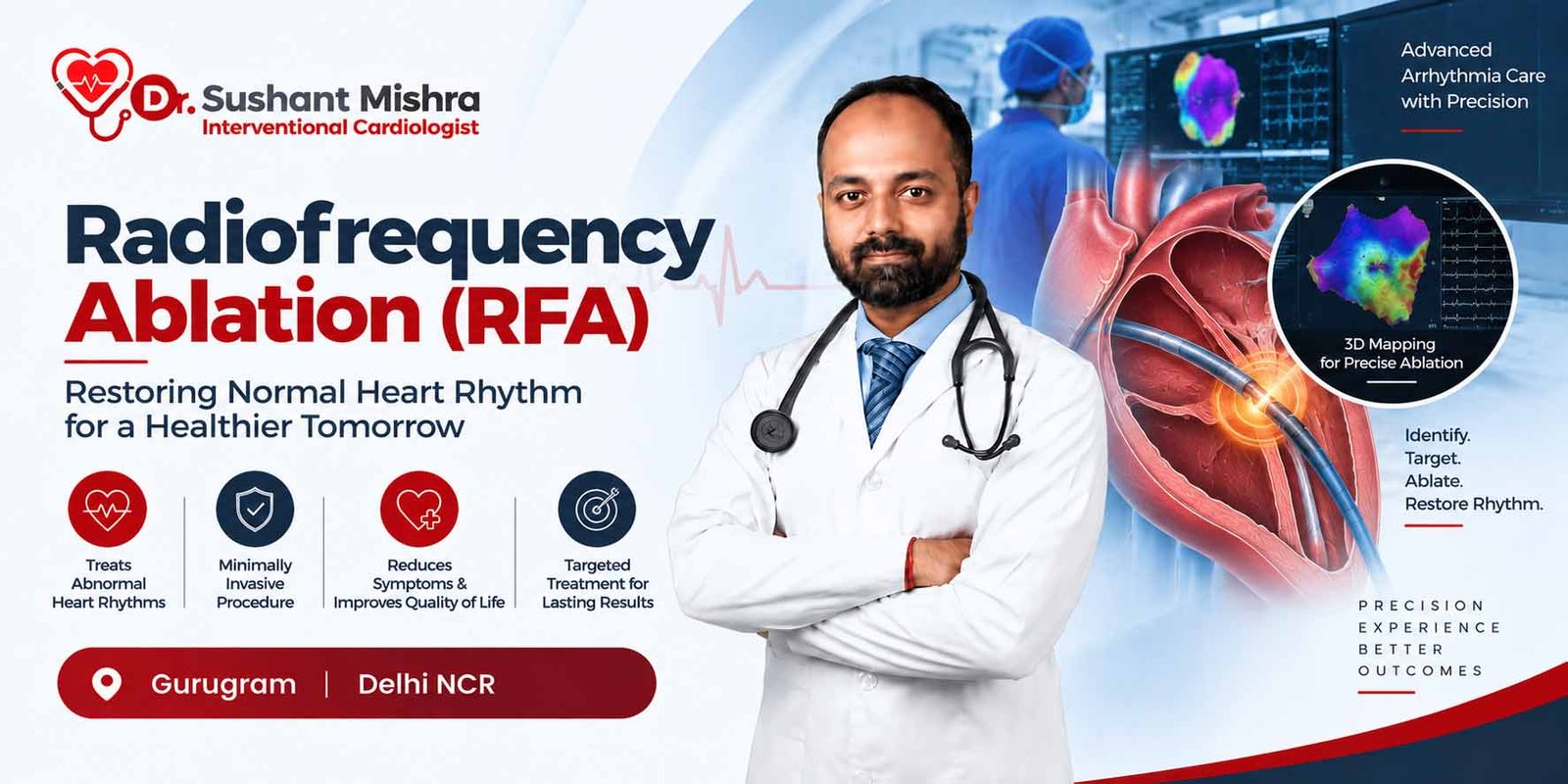
The heart depends on a carefully coordinated electrical system to maintain a regular rhythm. When abnormal electrical signals develop, the heart may beat too quickly, irregularly or inefficiently. These abnormal rhythms are known as arrhythmias.
Radiofrequency Ablation (RFA), also known as radiofrequency catheter ablation, is a minimally invasive procedure used to treat selected heart rhythm disorders. During the procedure, specialized catheters are guided into the heart to locate the source of abnormal electrical activity. Radiofrequency energy is then applied to a very small targeted area of tissue responsible for the abnormal signals.
Patients looking for RFA in Gurugram can consult Dr. Sushant Mishra for cardiac evaluation and individualized treatment planning.
Radiofrequency ablation is a catheter-based treatment for certain abnormal heart rhythms.
The procedure uses controlled radiofrequency energy to create a small area of scar tissue at the site responsible for abnormal electrical signals. This tissue modification can interrupt the abnormal electrical pathway and help restore or maintain a more appropriate heart rhythm.
RFA is performed without conventional open-heart surgery.
RFA may be considered when a patient has an arrhythmia arising from an identifiable abnormal electrical pathway or focus.
Depending on the type of arrhythmia and individual clinical circumstances, catheter ablation may be used in the management of conditions such as:
The American Heart Association notes that catheter ablation is commonly used for SVT and can also be used for other rhythm disorders including atrial flutter and atrial fibrillation.
Patients with an abnormal heart rhythm may experience different symptoms depending on the type and severity of the arrhythmia.
Common symptoms can include:
Heart palpitations: A sensation of racing, pounding, fluttering or irregular heartbeats.
Dizziness or light-headedness: An abnormal rhythm can sometimes affect effective blood circulation.
Shortness of breath: Some patients experience breathing difficulty during episodes of rapid heart rhythm.
Chest discomfort: Certain arrhythmias may be associated with chest discomfort.
Fainting or near-fainting: Significant rhythm disturbances can sometimes cause syncope or near-syncope.
Symptoms alone cannot determine the type of arrhythmia, so appropriate cardiac evaluation is important.
Before recommending radiofrequency ablation, the cardiology team needs to identify the type and source of the abnormal heart rhythm.
Evaluation may include an ECG, Holter or other ambulatory rhythm monitoring, echocardiography, and other tests depending on the patient's symptoms.
An Electrophysiology Study (EPS) may also be performed. During an EP study, specialized electrode catheters record electrical signals from different areas of the heart and help identify where the arrhythmia originates.
RFA is generally performed in an electrophysiology or cardiac catheterization laboratory.
Thin catheters are introduced through a blood vessel and guided toward the heart. Specialized electrodes record electrical signals and help create a map of the heart's electrical activity.
Once the abnormal electrical pathway or focus is identified, the ablation catheter is positioned at the targeted location. Radiofrequency energy is then delivered to modify a small area of tissue responsible for the abnormal rhythm.
The exact procedure varies according to the type and complexity of the arrhythmia.
An EP Study and RFA are closely related but serve different purposes.
An EP study is primarily used to understand the heart's electrical system and locate the source of an arrhythmia.
RFA is the therapeutic component used to treat the identified abnormal electrical pathway or focus.
When an appropriate rhythm problem is identified during an EP study, catheter ablation may sometimes be performed during the same procedural session.
For appropriately selected patients, RFA provides a catheter-based approach to treating the electrical source of certain arrhythmias rather than only controlling symptoms.
Potential benefits may include reducing episodes of abnormal rhythm, improving arrhythmia-related symptoms and, in some situations, reducing dependence on rhythm-control medication.
Results vary considerably according to the specific arrhythmia and individual patient factors, so expected outcomes should be discussed before treatment.
RFA is not conventional open-heart surgery.
It is a minimally invasive catheter-based procedure. Catheters are introduced through blood vessels and guided into the heart, so a large chest incision is generally not required.
Catheter ablation is an established treatment for selected cardiac arrhythmias, but it is still an invasive procedure and has potential complications.
Possible risks can include bleeding or infection at the catheter insertion site, blood-vessel injury, blood clots, damage to cardiac structures and development of other rhythm disturbances. The individual risk depends on the arrhythmia being treated, procedure complexity and the patient's overall health.
After the procedure, patients are monitored while the catheter access site recovers. Heart rhythm, blood pressure and other vital signs are checked.
The timing of discharge and return to normal activities varies according to the procedure and individual condition. Patients receive specific instructions about medicines, physical activity and care of the catheter insertion site.
Regular follow-up may be recommended to assess symptoms and heart rhythm after treatment.
Patients experiencing recurrent palpitations, episodes of rapid heartbeat or a diagnosed cardiac arrhythmia can consult Dr. Sushant Mishra in Gurugram for further evaluation.
His website currently lists RFA under Comprehensive Heart & Vascular Care and lists his Gurugram practice locations at Hridaya Clinic and PB Health Hospital.
The decision to perform RFA should be based on the specific rhythm diagnosis, symptoms, previous treatment, cardiac investigations and overall health.
If you have recurrent rapid heartbeat, palpitations, an established arrhythmia, or have been advised an EP Study or RFA, consult Dr. Sushant Mishra for evaluation and treatment planning.
Radiofrequency ablation is a type of catheter ablation that uses radiofrequency energy to target a small area of tissue responsible for certain abnormal electrical signals.
No. Cardiac RFA is generally performed using thin catheters introduced through blood vessels rather than through conventional open-heart surgery.
An EP study helps locate and characterize abnormal electrical activity. RFA is a treatment that can target the tissue responsible for the abnormal rhythm.
No. Whether catheter ablation is appropriate depends on the specific rhythm disorder, symptoms, previous treatment and other clinical factors.
Yes. Recurrence can occur, and the likelihood varies with the type of arrhythmia and individual circumstances. Some patients may require additional treatment or repeat ablation. For example, the AHA notes that atrial fibrillation can recur after ablation.
