- drsushant@gmail.com
- 088009 16525
- OPD: 06:00PM - 08:00PM
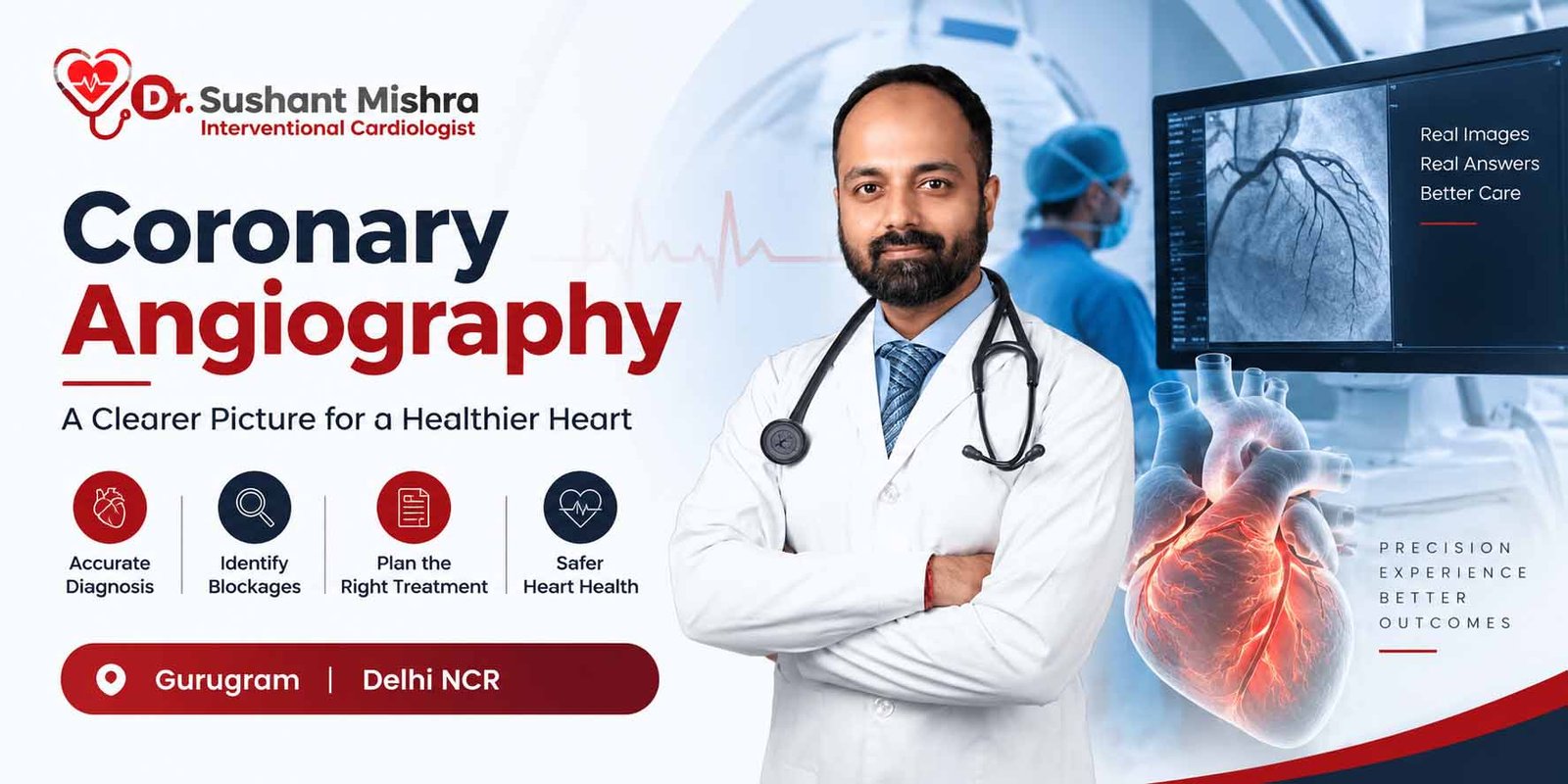
Coronary angiography is an important diagnostic procedure used to examine the coronary arteries and identify narrowing or blockages that may reduce blood flow to the heart. It can help a cardiologist determine the location and severity of coronary artery disease and decide whether treatment with medicines, angioplasty, stenting, bypass surgery, or another approach should be considered.
Patients looking for coronary angiography in Gurugram can consult Dr. Sushant Mishra, an Interventional Cardiologist trained at PGIMER Chandigarh and AIIMS New Delhi. His clinical expertise includes coronary interventions, complex and high-risk PCI, CTO procedures, IVUS/OCT-guided interventions, FFR, and low- or zero-contrast PCI in selected patients with renal dysfunction.
Coronary angiography is a catheter-based test that allows the cardiologist to visualize the arteries supplying blood to the heart.
During the procedure, a thin catheter is passed through an artery, commonly from the wrist or groin, and carefully guided toward the heart. Contrast material is introduced and X-ray imaging is used to create detailed pictures of the coronary arteries.
These images help identify whether an artery is normal, narrowed, or significantly blocked.
A cardiologist may recommend coronary angiography when symptoms or previous investigations suggest possible coronary artery disease. It may be considered for patients experiencing persistent or recurrent chest pain, unexplained shortness of breath, suspected acute coronary syndrome, abnormal cardiac tests, or symptoms suggestive of reduced blood supply to the heart.
It may also be performed during evaluation of certain patients with a heart attack or before planning an interventional cardiac procedure.
The decision to perform angiography depends on the patient's symptoms, medical history, examination and results of other cardiac investigations.
Coronary angiography can provide important information about:
The results help the cardiologist determine an appropriate treatment strategy.
Before the procedure, Dr. Sushant Mishra and the medical team evaluate the patient's medical history, current medications, kidney function and other relevant health factors.
The catheter insertion area is cleaned and local anaesthesia is generally administered. A thin catheter is then introduced through an artery in the wrist or groin and guided toward the coronary arteries under imaging.
Contrast is administered while X-ray images are recorded. Dr. Mishra can then assess the coronary arteries for significant narrowing or blockage.
After the diagnostic procedure, the catheter is removed and the access site is monitored.
Finding a coronary blockage does not automatically mean that every patient needs angioplasty.
Treatment depends on several factors, including the severity and location of the blockage, symptoms, overall coronary anatomy, heart function and the patient's general health.
Depending on the findings, treatment may involve medical therapy and risk-factor management, coronary angioplasty with stent placement, coronary artery bypass grafting (CABG), or additional assessment.
Dr. Mishra's website lists expertise in primary angioplasty, complex/high-risk coronary interventions, CTO, IVUS/OCT coronary imaging and FFR.
In complex coronary disease, angiography may be supplemented by technologies that provide additional information about an artery or blockage.
Dr. Sushant Mishra's listed areas of expertise include IVUS (Intravascular Ultrasound), OCT (Optical Coherence Tomography), FFR, CTO intervention, rotational atherectomy (ROTA), IVL and complex high-risk coronary intervention.
These technologies are used selectively depending on the clinical situation and can assist with assessment and procedural planning.
Contrast exposure is an important consideration in patients with impaired kidney function. Dr. Mishra's profile specifically lists experience with zero-, low- and ultra-low-contrast PCI in patients with renal dysfunction.
Patients with kidney disease therefore require individual assessment before angiography or intervention. The appropriate strategy depends on kidney function, coronary anatomy, clinical urgency and other medical factors.
Before undergoing angiography, patients should tell their cardiologist about all medications they take, previous reactions to contrast material, kidney problems, diabetes, bleeding disorders and other medical conditions.
Patients should follow the specific instructions provided by their treating team regarding fasting and medicines. Do not stop prescribed medicines independently unless instructed by the treating doctor.
Coronary angiography is routinely performed in cardiac care, but like any invasive procedure it has potential risks.
Possible complications can include bleeding or bruising at the catheter insertion site, allergic reaction to contrast, kidney-related complications, abnormal heart rhythms, blood-vessel injury and, less commonly, more serious cardiovascular complications.
Individual risk varies, so patients should discuss the expected benefits and potential risks with their cardiologist before the procedure.
Dr. Sushant Mishra is an Interventional Cardiologist with training from PGIMER Chandigarh and AIIMS New Delhi. His practice covers complex coronary interventions, structural heart interventions, peripheral vascular interventions, cardiac devices and heart-failure therapies.
His website currently lists consultations at Hridaya Clinic, South City 2/Sector 49, Gurugram, and PB Health Hospital, DLF Phase II, Gurugram.
If you have recurrent chest discomfort, breathlessness, an abnormal cardiac test, known coronary artery disease, or have been advised to undergo coronary angiography, you can consult Dr. Sushant Mishra for evaluation and discussion of the appropriate next steps.
