- drsushant@gmail.com
- 088009 16525
- OPD: 06:00PM - 08:00PM
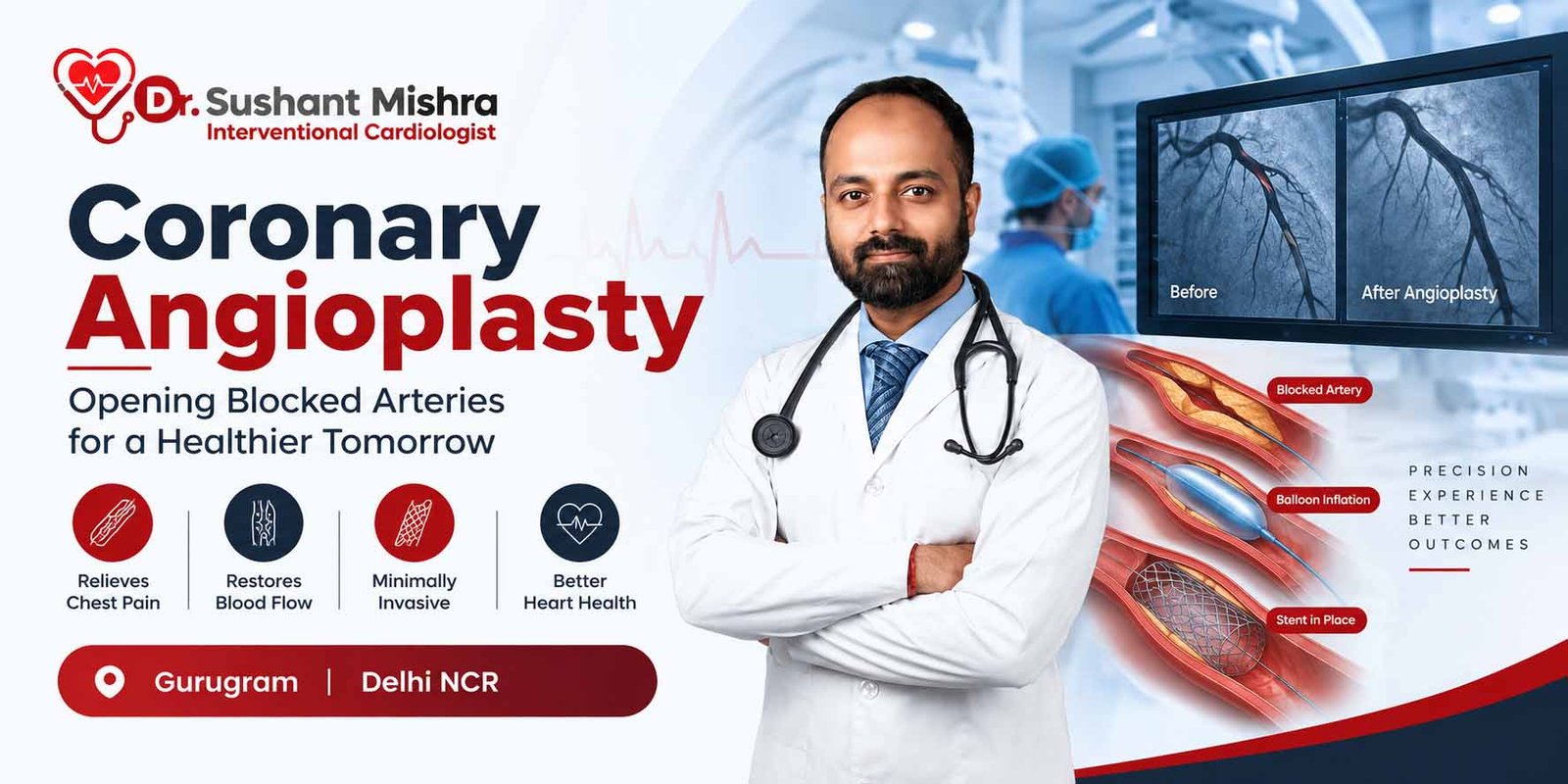
Coronary angioplasty, also known as Percutaneous Coronary Intervention (PCI), is a minimally invasive procedure used to open narrowed or blocked coronary arteries and restore blood flow to the heart. It is commonly performed in patients with significant coronary artery disease and may also be required urgently during certain types of heart attack.
Patients looking for coronary angioplasty in Gurugram can consult Dr. Sushant Mishra, an Interventional Cardiologist trained at PGIMER Chandigarh and AIIMS New Delhi. His expertise includes primary angioplasty, complex and high-risk coronary interventions, CTO intervention, ROTA, IVL, IVUS/OCT-guided procedures and FFR.
Coronary angioplasty is a catheter-based procedure used to improve blood flow through a narrowed or blocked coronary artery.
During the procedure, a thin catheter is guided through a blood vessel toward the affected coronary artery. A small balloon is positioned across the narrowing and inflated to widen the artery. In many cases, a coronary stent is then placed to help keep the artery open.
Unlike bypass surgery, angioplasty does not require opening the chest.
Angioplasty may be considered when a significant coronary blockage is affecting blood flow to the heart. Depending on the patient's individual condition, it may be considered for persistent angina despite appropriate medical treatment, acute coronary syndrome, certain heart attacks, or significant coronary artery narrowing identified during angiography.
Dr. Mishra’s existing patient-education material also discusses angioplasty for stable or unstable angina, heart attack and severe coronary narrowing.
The decision to perform angioplasty should be individualized after assessing symptoms, coronary anatomy, test results, heart function and overall health.
The procedure generally begins by obtaining arterial access, commonly through the wrist or groin. A catheter is carefully advanced to the coronary arteries under imaging guidance.
Once the blockage is identified, a guidewire is passed across the narrowed area. A balloon may then be inflated to widen the artery. A stent is commonly deployed at the treated segment to help maintain blood flow.
The exact technique varies depending on the location, severity and complexity of the coronary blockage.
A coronary stent is a small mesh-like device that supports the artery after it has been widened.
Modern angioplasty frequently involves the use of drug-eluting stents. The choice of stent, technique and treatment strategy depends on the patient's coronary anatomy and clinical condition.
Patients should follow their cardiologist's instructions regarding antiplatelet medicines after stent placement and should not discontinue prescribed medication without medical advice.
Not every coronary blockage is straightforward. Some patients may have heavily calcified arteries, chronic total occlusions, bifurcation disease, multiple blockages or other complex coronary anatomy.
Dr. Sushant Mishra's documented expertise includes:
These techniques may be considered selectively according to the patient's coronary anatomy and clinical requirements.
IVUS (Intravascular Ultrasound) and OCT (Optical Coherence Tomography) provide detailed information from inside a coronary artery.
In selected cases, intravascular imaging can help the interventional cardiologist evaluate the lesion, determine appropriate stent sizing and assess the result after stent placement.
Dr. Mishra's profile specifically identifies IVUS/OCT coronary imaging as part of his coronary intervention expertise.
Patients with impaired kidney function may require special consideration because conventional coronary procedures often involve contrast material.
Dr. Sushant Mishra lists zero-, low- and ultra-low-contrast PCI in patients with renal dysfunction among his areas of expertise.
The suitability of such an approach depends on kidney function, coronary anatomy, procedural complexity and the patient's overall clinical condition.
Angioplasty and coronary artery bypass grafting (CABG) are different methods of restoring blood flow to the heart.
Angioplasty is catheter-based and minimally invasive, whereas bypass surgery creates an alternative route around significantly narrowed or blocked arteries.
One treatment is not automatically better for every patient. The appropriate approach depends on the number and location of blockages, complexity of coronary disease, diabetes, heart function, other medical conditions and individual clinical circumstances.
When clinically appropriate, coronary angioplasty can restore blood flow through a significantly narrowed or blocked coronary artery without open-heart surgery.
It may help reduce angina and improve symptoms caused by inadequate blood flow. In certain acute heart attacks, urgent PCI is used to reopen an occluded coronary artery and restore blood flow as quickly as possible.
Individual benefits and risks should always be discussed with the treating cardiologist.
Coronary angioplasty is a commonly performed cardiac intervention, but it is an invasive medical procedure and carries potential risks.
These can include bleeding or bruising at the access site, allergic or kidney-related effects from contrast, blood-vessel complications, abnormal heart rhythm, stent thrombosis and, less commonly, serious complications such as heart attack or stroke.
The individual risk depends on factors including age, kidney function, heart function, coronary anatomy and other medical conditions.
Recovery varies according to the type and complexity of the procedure and the patient's overall health.
Patients should follow their cardiologist's instructions regarding physical activity, medicines, wound care, diet and follow-up appointments. Medicines prescribed after stent implantation are particularly important and should not be stopped without medical guidance.
Dr. Sushant Mishra is an Interventional Cardiologist trained at PGIMER Chandigarh and AIIMS New Delhi. His practice encompasses coronary interventions as well as structural heart, peripheral vascular, device and heart-failure interventions.
His website currently lists clinical practice in Gurugram, including Hridaya Clinic, and the homepage also identifies him as a Consultant Interventional Cardiologist at Artemis Hospitals, Gurugram.
If you have been diagnosed with coronary artery disease, have been advised angioplasty or stent placement, or want an expert opinion about a coronary blockage, you can consult Dr. Sushant Mishra for individualized evaluation.
Angioplasty refers to opening a narrowed or blocked coronary artery. A stent is commonly placed during PCI to help keep the treated artery open.
No. Coronary angioplasty is a catheter-based, minimally invasive procedure and does not require opening the chest.
Yes. The radial artery in the wrist is commonly used for coronary procedures, although the most appropriate access site depends on the individual case.
No. Treatment depends on symptoms, severity and location of blockages, test results, coronary anatomy and other clinical factors. Some patients can be managed medically, while others may require PCI or bypass surgery.
Some patients with kidney dysfunction can undergo PCI after careful assessment. Dr. Mishra's profile lists expertise in zero-, low- and ultra-low-contrast PCI for patients with renal dysfunction.
