- drsushant@gmail.com
- 088009 16525
- OPD: 06:00PM - 08:00PM
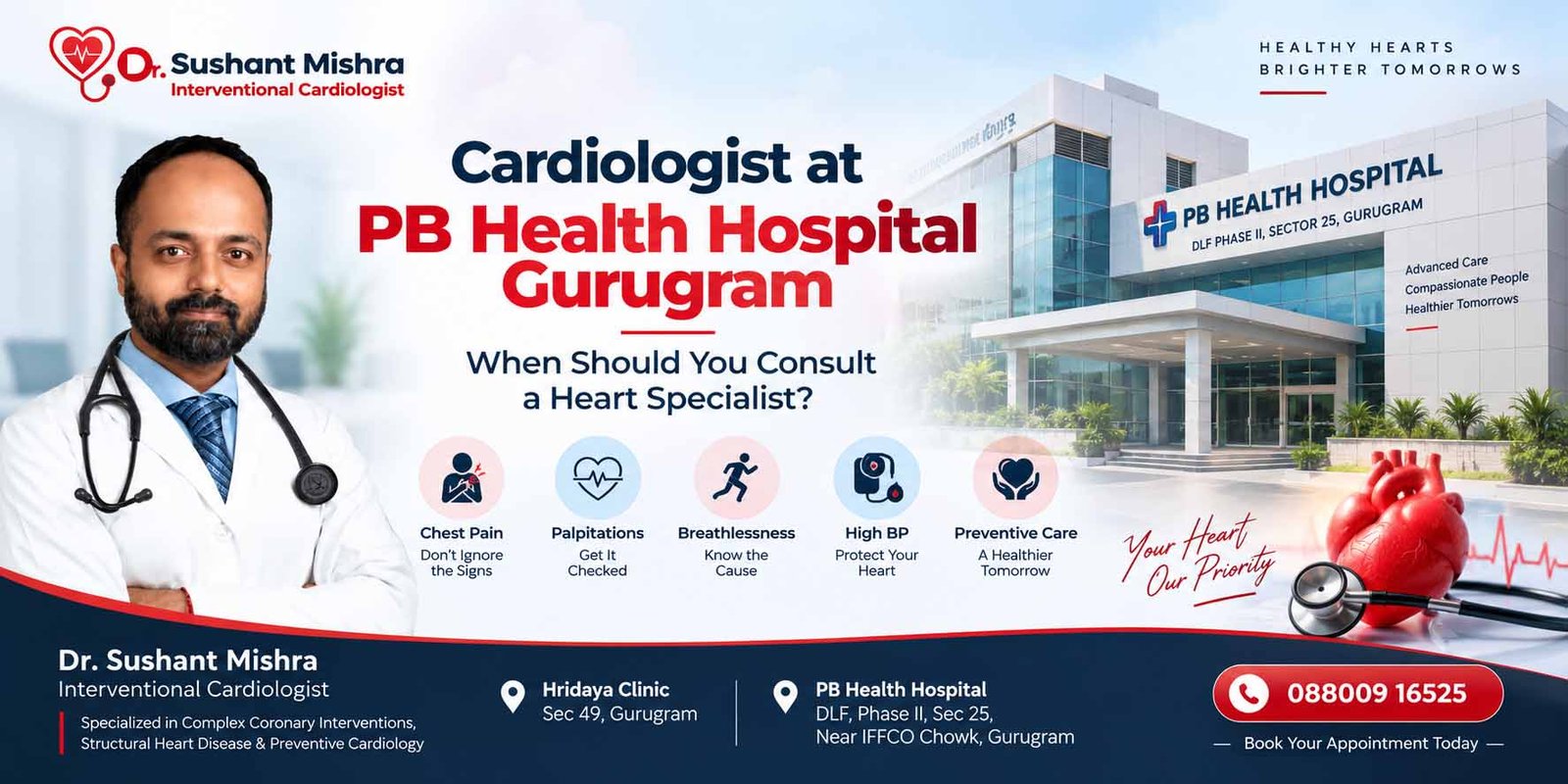
Heart disease does not always begin with severe chest pain or a medical emergency. In many people, the first warning signs may be subtle—shortness of breath, unusual tiredness, palpitations, dizziness, reduced exercise capacity, or discomfort in the chest.
Recognizing these symptoms and getting evaluated at the right time can help identify cardiovascular problems earlier and guide appropriate treatment.
If you are looking for a Cardiologist at PB Health Hospital Gurugram, Dr. Sushant Mishra provides consultation and interventional cardiology care for patients with a range of heart and vascular conditions. His professional profile includes training in Internal Medicine at PGIMER Chandigarh and Cardiology at AIIMS New Delhi.
Not every episode of discomfort indicates heart disease. However, certain symptoms and risk factors should not be ignored, particularly when they are new, persistent, recurrent, or worsening.
Chest pressure, tightness, heaviness, squeezing, or discomfort—particularly during physical activity—can sometimes be related to reduced blood flow to the heart.
Chest symptoms can have many causes, but cardiovascular causes need to be considered based on the person's symptoms and risk factors.
New or severe chest pain, especially with sweating, breathlessness, nausea, fainting, or pain spreading to the arm, back, neck or jaw, requires urgent medical attention rather than waiting for a routine appointment.
Feeling unusually breathless while walking, climbing stairs, exercising, or even at rest can sometimes be associated with cardiovascular conditions.
A cardiology evaluation may be appropriate when breathlessness is unexplained, progressively worsening, associated with chest discomfort, or accompanied by swelling in the feet or ankles.
A sensation that your heart is racing, pounding, fluttering, skipping beats, or beating irregularly is commonly described as a palpitation.
Occasional palpitations are not necessarily caused by serious heart disease. However, recurrent episodes—particularly when accompanied by dizziness, fainting, chest discomfort or breathlessness—may require further evaluation.
Depending on the clinical situation, investigations such as an ECG, Holter monitoring, Electrophysiology Study (EPS) or other rhythm assessments may be considered.
Dr. Sushant Mishra's listed areas of expertise include cardiac electrophysiology procedures such as EPS and RFA, as well as cardiac device therapies.
High blood pressure can gradually affect the heart and blood vessels, often without obvious symptoms.
Patients with persistent hypertension may need assessment of their overall cardiovascular risk along with appropriate management of blood pressure, cholesterol, diabetes, weight and lifestyle factors.
Regular monitoring becomes particularly important when hypertension occurs together with other cardiovascular risk factors.
Diabetes is an important risk factor for cardiovascular disease.
For people with diabetes, heart-health assessment should extend beyond blood glucose alone. Blood pressure, cholesterol, weight, physical activity, smoking status, kidney function and other risk factors may also need attention.
People with diabetes who develop chest discomfort, unexplained breathlessness or reduced exercise tolerance should discuss these symptoms with their treating doctor.
High levels of LDL cholesterol can contribute to the development of plaque within the arteries.
Over time, plaque buildup can narrow coronary arteries and contribute to coronary artery disease. Your doctor can assess your overall cardiovascular risk and determine whether lifestyle changes, medication or additional investigations are appropriate.
Dizziness and fainting can occur for many reasons, and not all are related to the heart.
However, unexplained or recurrent fainting may sometimes be associated with abnormal heart rhythms or other cardiovascular problems.
If a cardiac rhythm disorder is suspected, further investigations may be recommended to determine the cause.
People with a strong family history of premature cardiovascular disease may benefit from discussing their individual risk factors with a doctor.
This is particularly relevant when family history is combined with high blood pressure, diabetes, high cholesterol, smoking, obesity or a sedentary lifestyle.
The goal should be individual risk assessment and prevention, rather than waiting for symptoms to develop.
An interventional cardiologist specializes in diagnosing cardiovascular conditions and performing catheter-based procedures when clinically appropriate.
Dr. Sushant Mishra's documented areas of expertise include coronary interventions, complex and high-risk PCI, CTO interventions, IVUS/OCT and FFR, low/zero-contrast PCI in patients with renal dysfunction, structural heart interventions, peripheral vascular interventions, pacemaker and ICD therapies, and heart failure interventions.
Depending on a patient's condition, evaluation or treatment may involve procedures such as:
The appropriate procedure depends on the patient's diagnosis and clinical findings.
There is no single heart test that every patient needs.
After reviewing symptoms, medical history, risk factors and performing a clinical examination, a cardiologist may recommend investigations such as an ECG, echocardiography, blood tests, Holter monitoring, exercise testing, coronary imaging or coronary angiography, depending on the clinical situation.
The purpose is to select investigations based on the patient's individual needs rather than performing unnecessary tests.
Some cardiovascular diseases develop gradually and may remain unnoticed until symptoms become significant.
Timely medical evaluation can help identify risk factors, investigate symptoms, establish a diagnosis and determine whether lifestyle modification, medication, monitoring or an interventional procedure is appropriate.
Preventive heart care is particularly important for people with diabetes, hypertension, high cholesterol, obesity, tobacco use or a family history of premature cardiovascular disease.
Dr. Sushant Mishra is a Consultant Interventional Cardiologist whose current website lists his association with PB Health Hospital, Gurugram. His training includes MD Medicine from PGIMER Chandigarh and DM Cardiology from AIIMS New Delhi.
His cardiovascular practice includes management of coronary artery disease, complex coronary interventions, structural heart procedures, cardiac rhythm disorders and cardiac device therapies.
A routine cardiology consultation should not delay emergency treatment.
Seek urgent medical care for symptoms such as severe or persistent chest pain, sudden severe breathlessness, fainting with chest symptoms, or other symptoms suggesting a possible heart attack or serious cardiovascular emergency.
If you have persistent chest discomfort, breathlessness, palpitations, unexplained dizziness, high blood pressure, diabetes, high cholesterol or other cardiovascular risk factors, a medical evaluation can help determine whether further cardiac testing or treatment is needed.
For consultation with Dr. Sushant Mishra at PB Health Hospital, Gurugram, patients can schedule an appointment for individualized cardiovascular assessment and treatment planning.
His current website lists consultations at PB Health Hospital, DLF Phase II, Sector 25, near IFFCO Chowk, Gurugram, as well as Hridaya Clinic in Sector 49.
Consider medical evaluation for persistent or recurrent chest discomfort, unexplained breathlessness, palpitations, dizziness or fainting, or when cardiovascular risk factors require assessment.
Yes. His documented expertise includes coronary angioplasty and complex/high-risk coronary interventions, including image-guided procedures.
His documented expertise includes EPS, RFA, pacemaker implantation and ICD/AICD-related cardiac device therapies.
Dr. Mishra's website currently provides 088009 16525 as the appointment/contact number.
